
|
Quantity
|
Out of stock
|
||
|
|
|||
|
|
|||
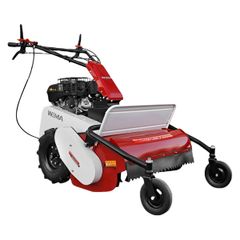
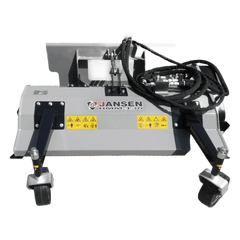
Where an ordinary mower gives up — tall grass, weeds, scrub, branches and self-seeded growth — a mulcher takes over. Flail blades chop the vegetation into fine clippings that stay on the ground as natural mulch.
Mulcher or flail mower
Routine lawn care needs only lighter equipment. Neglected plots, orchards, verges and brush-covered ground call for a stronger mulcher with solid flails and adequate working width.
What to look for
Working width, blade type (Y-flails versus hammers), drive power and mounting — on a two-wheel tractor, a mini-tractor or self-propelled — all matter. The denser the growth, the more power headroom you want.
We will help match a mulcher to your area and type of vegetation. Warranty and delivery across Poland.
FAQ — Flail mowers / mulchers for tractors
How much does a tractor-mounted flail mower cost?
Prices in our range start around 8056 zł for smaller models like the Jansen EFG-125 and go up to 25642 zł for large hydraulic units with a boom arm, such as the Jansen HMM-170. Price depends on working width, drive type (PTO vs hydraulic) and mounting style.
Front-mounted or rear-mounted — which to choose?
A front-mounted mower (e.g. Jansen BMM-130, HMM-130) attaches to the front of a tractor or excavator, giving better visibility while mowing. A rear-mounted mower (e.g. Jansen EFGCH-135, EFGCH-195) attaches at the back, often with hydraulic side-shift, which makes mowing along slopes and obstacles easier.
Hydraulic drive or PTO (power take-off)?
A hydraulic model, e.g. Jansen BM-120 for excavators, mounts on machines without a PTO and is powered by the carrier's hydraulic system. A PTO-driven model, e.g. Jansen HMS-80/180, requires a tractor with a power take-off shaft — the standard setup for typical tractor-mounted flail mowers.
Which mower is best for mowing slopes and ditches?
For slopes and hard-to-reach terrain, boom-mounted hydraulic models work best, e.g. Jansen HMS-80/180 or HMS-100/180 — the boom lets you mow at an angle and reach spots a standard front or rear mower can't.
What's the difference between the EFG, EFGC and EFGCH lines?
It's a growing lineup by width and features: EFG (e.g. EFG-125) is the basic flail mower, EFGC (from EFGC-145 to EFGC-220) offers wider working widths, and EFGCH (from EFGCH-135 to EFGCH-195) adds hydraulic side-shift for uneven terrain and obstacles.